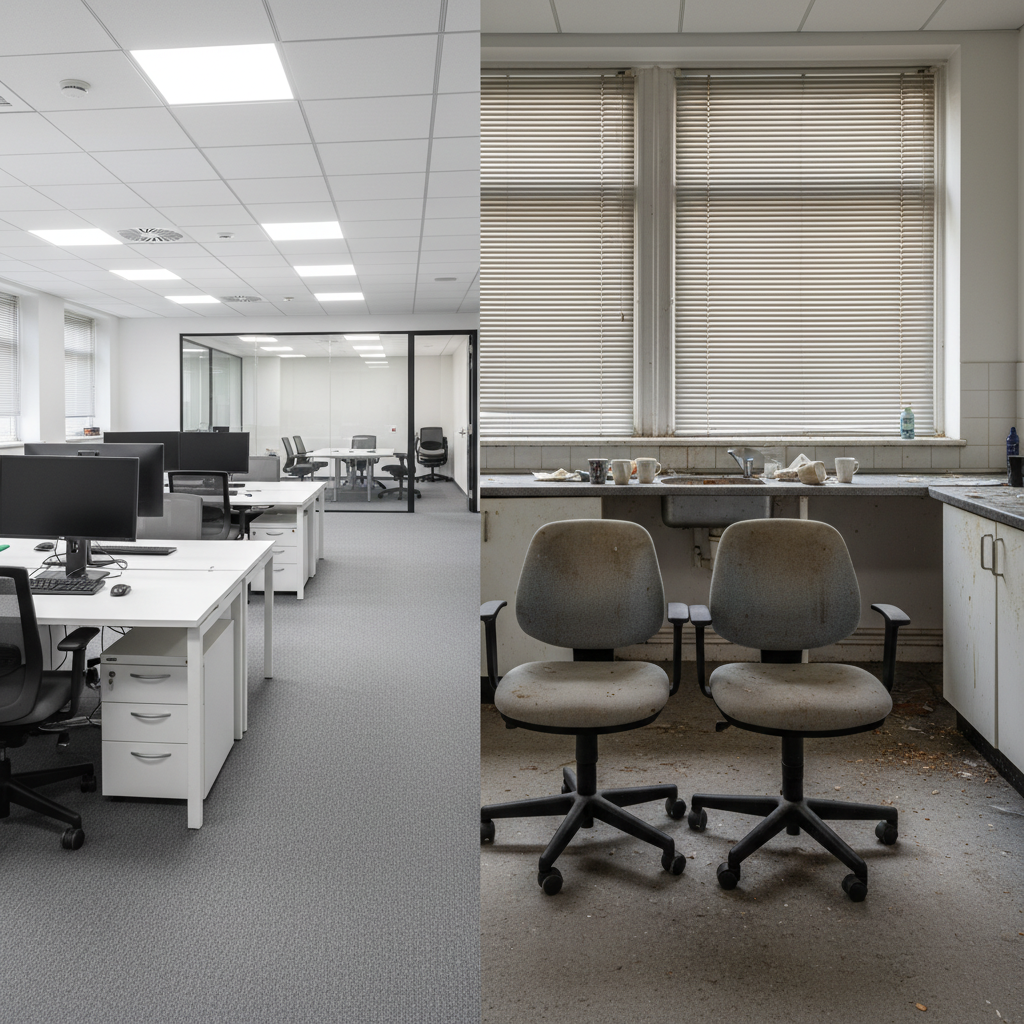
The Clean That Got Postponed — Then Postponed Again
It starts with a budget review. The deep clean gets pushed to next quarter. Next quarter arrives, something else takes priority, and suddenly it’s been 14 months since anyone has properly scrubbed behind the kitchen units or sanitised the ventilation grilles in the meeting rooms.
This isn’t a rare story. It’s one of the most common patterns we see with commercial premises across Bristol — offices, schools, retail spaces, and managed blocks where maintenance cleaning has been ticking along, but the deeper, periodic work keeps getting deferred.
The consequences aren’t always dramatic at first. That’s exactly what makes this pattern so easy to fall into.
What “Maintenance Clean” Actually Covers
Daily or weekly maintenance cleaning keeps surfaces visibly tidy. It handles bins, vacuuming, wiping down desks, cleaning toilets and sinks. For most commercial premises, this is what’s running week to week.
But maintenance cleaning isn’t designed to reach the places that accumulate grime slowly and invisibly. Carpet fibres. Extractor fans. The grouting between floor tiles in a staff kitchen. Upholstered seating. The undersides of desks. These areas don’t look dirty — until they really do.
If you’re not sure whether your current setup is actually enough, it’s worth reading through the differences between an office deep clean and a maintenance clean before making any decisions about frequency or scope.
A Realistic Bristol Example
Consider a mid-sized professional services firm in central Bristol. Around 40 staff, open-plan office, shared kitchen, two meeting rooms that get heavy use. They had a reliable weekly maintenance clean in place but hadn’t scheduled a deep clean in over a year.
When they finally brought in a cleaning team for a full commercial cleaning Bristol service, here’s what the team found:
- Carpet tiles throughout the main office had built up enough embedded dirt that extraction cleaning shifted the water black within minutes
- The kitchen extractor fan had a grease buildup significant enough to be a minor fire risk — not flagged by anyone in routine checks
- Meeting room chairs had visible staining that regular cleaning had never addressed
- The washroom floor grouting had discoloured to the point where even strong product couldn’t fully restore it — replacement became necessary for two sections
- Blinds throughout the office had accumulated dust that was visibly affecting air quality for staff with allergies
None of this appeared overnight. It built up gradually, in a premises that staff would have described as “generally clean.”
The Real Costs of Deferring
There’s an assumption that skipping a commercial deep clean is a straightforward cost saving. In practice, it often works out the opposite way.
Grease buildup in kitchen extraction systems becomes a fire hazard — and in a commercial premises, that’s a liability and insurance issue, not just a hygiene one. Carpet and upholstery that could have been restored with extraction cleaning at an earlier stage sometimes reaches the point of needing replacement. That’s a significant cost difference.
For Bristol businesses in leased premises, dilapidations at the end of a lease can include cleaning and restoration costs that a periodic deep clean schedule would have avoided entirely. Commercial landlords and property managers are increasingly specific about this in lease agreements.
Staff and Client Impressions
There’s a less quantifiable cost too. Staff notice when a workplace feels genuinely clean versus surface-level tidy. The smell of a space, the condition of soft furnishings, the state of shared facilities — these things affect how people feel about where they work.
Clients and visitors notice too. A first meeting in a space that smells faintly of accumulated grime, or has visibly tired upholstery, creates an impression that no amount of good work in the meeting itself entirely counteracts.
This matters more in client-facing industries — professional services, healthcare, retail, hospitality — but it’s relevant to most commercial spaces. People form quick judgements about organisations based on their environments.
How Often Should a Deep Clean Actually Happen?
There’s no single answer — it depends on the type of premises, footfall, how intensively the space is used, and what’s happening in the kitchen or welfare facilities.
A rough guide for most Bristol commercial premises:
- Offices with 10–30 staff: Two to three times per year, plus after any significant events or fit-out works
- High-footfall retail or hospitality: Quarterly as a minimum, with monthly for back-of-house areas like kitchens
- Schools and healthcare premises: At minimum every school holiday or clinical review cycle, with full deep cleans typically in summer and at Christmas
- Managed blocks and communal areas: Annually for full deep cleans, with more frequent attention to high-touch areas
If you’re currently running maintenance cleaning only and haven’t had a deep clean in over six months, it’s worth getting a quote just to understand the scope — most reputable providers will walk through the premises and tell you honestly what needs attention.
Scheduling It Properly
The businesses that handle this well treat the deep clean as a planned maintenance expense rather than something that gets done when problems become visible. They schedule it into the year in advance, typically timed around quieter periods — between Christmas and New Year, over bank holiday weekends, or during planned office closures.
This approach keeps costs predictable and avoids the kind of deterioration that becomes genuinely expensive to fix.
If you want to talk through what a sensible schedule might look like for your Bristol premises, the team at Clean Bees can help. We work with offices, schools, managed blocks, retail spaces, and more — and we’re straightforward about what’s actually needed rather than upselling for the sake of it. Get a free commercial cleaning quote and we can take it from there.
The Takeaway
Maintenance cleaning is essential. But it’s not a substitute for periodic deep cleaning — it was never designed to be. The spaces that stay in the best condition over time are the ones where both are running as planned, not competing for the same budget.
If your deep clean keeps getting deferred, the real question isn’t whether you can afford to do it. It’s whether you can afford to keep putting it off.