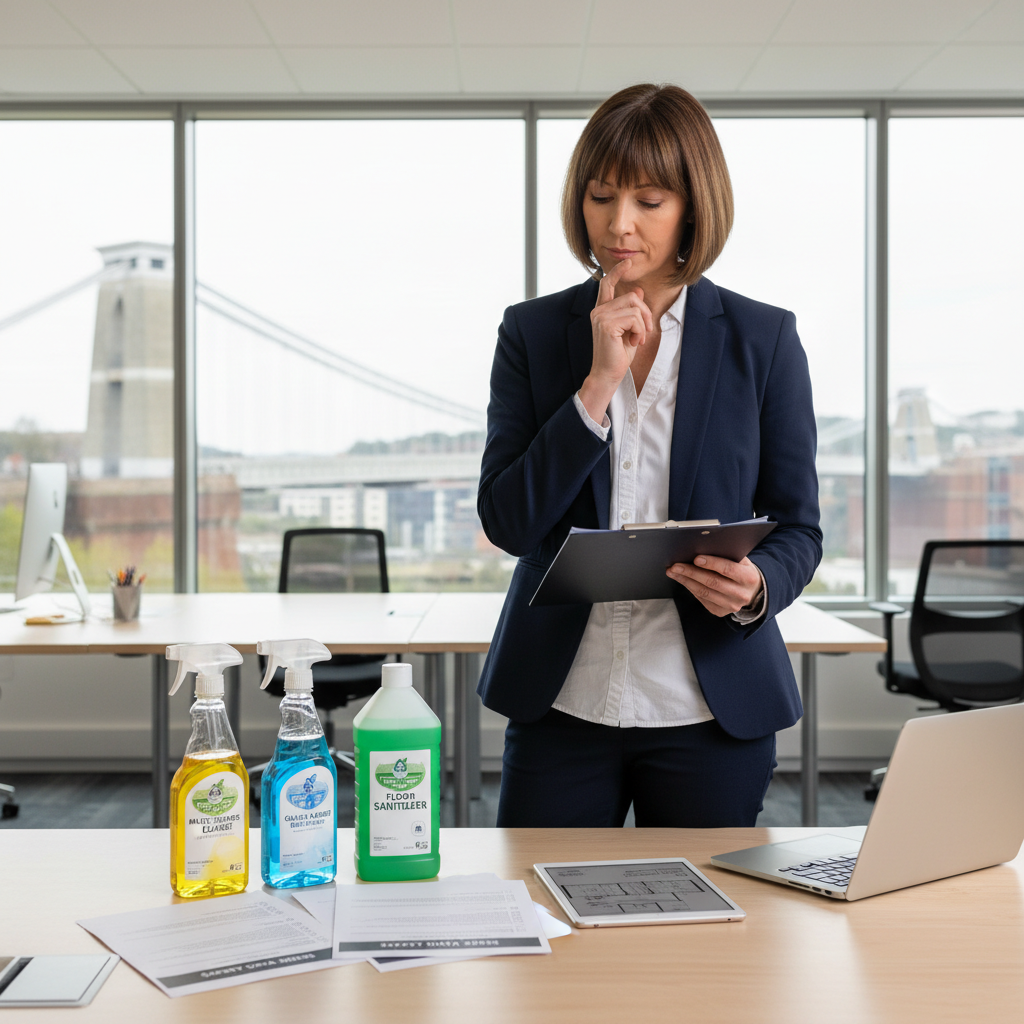
What Is COSHH and Why Should Bristol Business Owners Care?
COSHH stands for Control of Substances Hazardous to Health. It’s a set of UK regulations that require employers to control how hazardous substances are used, stored, and handled in the workplace. In a commercial cleaning context, that means the chemicals your cleaners bring into your building are your legal responsibility too — not just theirs.
Most business owners in Bristol assume COSHH is purely a concern for the cleaning company. It isn’t. If cleaning takes place on your premises, you have a duty of care to ensure that work is carried out safely. That applies whether you manage an office block, a school, a retail unit, or a shared communal space.
Getting this wrong isn’t just a paperwork issue. COSHH breaches can result in HSE enforcement notices, fines, and — in serious cases — prosecution. More practically, it puts your staff, cleaners, and visitors at risk.
The Basics: What COSHH Covers in a Cleaning Environment
Cleaning products are among the most commonly used hazardous substances in any workplace. Many contain bleach, ammonia, solvents, or surfactants that can cause skin irritation, respiratory problems, or chemical burns if handled incorrectly.
Under COSHH cleaning regulations, anyone using or overseeing these products must:
- Identify which substances are in use and assess the risks they pose
- Put control measures in place to reduce exposure
- Ensure appropriate PPE is available and actually used
- Store products safely and separately where required
- Keep Safety Data Sheets (SDS) accessible on-site
- Train staff who handle these substances
- Review assessments regularly and after any incidents
The regulations don’t require perfection. They require a reasonable, documented approach to managing risk. The key word there is documented. If something goes wrong and you can’t show you had a proper COSHH assessment in place, you’re exposed.
Who Is Responsible — You or Your Cleaning Contractor?
This is where a lot of Bristol businesses get tripped up. The short answer: both of you.
Your cleaning contractor is responsible for training their staff, producing COSHH assessments for the products they use, and ensuring their team works safely. But as the business owner or facilities manager, you’re responsible for the premises. That means checking your contractor actually has these documents in place, not just assuming they do.
When you hire a commercial cleaning service in Bristol, ask to see their COSHH assessments before work starts. A professional company should hand these over without hesitation. If they hedge or seem vague about it, that’s a red flag worth taking seriously.
You should also check that any products used on your site are appropriate for your environment. For example, a school has different requirements to a warehouse. Strong solvents that are fine in an industrial unit may not be suitable for classrooms where children are present shortly after cleaning takes place.
COSHH Risk Assessments: What They Actually Need to Include
A COSHH risk assessment doesn’t need to be a 40-page document. For most commercial cleaning contexts, it needs to clearly cover:
- The name and nature of each substance in use
- The route of exposure (inhalation, skin contact, ingestion)
- Who might be exposed and in what circumstances
- What control measures are in place
- What PPE is required
- Emergency procedures if someone is exposed
- Review dates
Keep copies on-site. If an HSE inspector visits or there’s an incident, these need to be available immediately — not filed away at your contractor’s office.
Practical Steps for Bristol Businesses
Here’s what to actually do if you want to get your COSHH compliance in order:
Step 1: Ask your current cleaning company for their COSHH assessments. You want a document for each product they use on your site. If they can’t provide these, you have a problem that needs addressing before anything else.
Step 2: Check the Safety Data Sheets. Every commercial cleaning product must come with an SDS from the manufacturer. These outline hazards, handling instructions, and emergency procedures. Your contractor should have these and make them available to you.
Step 3: Review your site-specific risks. Does your building have specific considerations — poor ventilation, food preparation areas, vulnerable building users? These need to be reflected in the assessments.
Step 4: Ensure PPE is available and used. Gloves and eye protection are the minimum for most cleaning tasks. Check that your cleaning team actually has and uses appropriate PPE, not just that it’s theoretically available somewhere.
Step 5: Set a review date. COSHH assessments should be reviewed annually or when products, processes, or premises change. Put it in the diary.
If any of this feels like a lot to manage on top of running your business, it’s worth reading our guide on commercial cleaning standards in Bristol — it covers the broader compliance picture and how to choose a contractor who takes this seriously.
Choosing a Contractor Who Takes COSHH Seriously
Not all cleaning companies approach compliance the same way. Some treat it as a tick-box exercise. Others build it into how they actually work.
When you’re evaluating a commercial cleaning contractor in Bristol, COSHH compliance is one of the clearer indicators of professionalism. Ask specific questions: Do they use COSHH-compliant products? Do they carry out site-specific risk assessments before starting work? Can they provide Safety Data Sheets for every product they’ll use?
A contractor who employs their staff directly (rather than using subcontractors or agency workers) tends to have better oversight of how products are handled on-site. Employed staff can be trained consistently, monitored, and held accountable in a way that self-employed or agency workers often can’t.
At Clean Bees, all cleaning operatives are directly employed, DBS-checked, and trained to work in compliance with COSHH requirements. We carry out site-specific risk assessments before starting any new contract and can provide full documentation on request.
A Quick Word on Eco-Friendly Products
There’s a common assumption that “natural” or “eco-friendly” cleaning products are automatically COSHH-exempt. They aren’t. Even plant-based or biodegradable products can cause skin or respiratory irritation in some people, and they still need to be assessed under COSHH if they’re being used in your workplace.
The good news is that many eco-friendly products do carry lower risk profiles, which can simplify your COSHH documentation. But they still need to be documented. Don’t skip the assessment just because the product is green.
Getting Help with COSHH Compliance
If you’re unsure where to start, the HSE website has free COSHH assessment templates and guidance for small businesses. Your cleaning contractor should also be a resource here — if they’re not able to help you understand what’s in use on your site and why it’s safe, that’s a sign you might want to look elsewhere.
For Bristol businesses looking for a cleaning partner who handles compliance properly from day one, get in touch with Clean Bees for a free commercial cleaning quote. We’ll walk you through our COSHH documentation, introduce you to our employed team, and show you exactly how we work — before you sign anything.