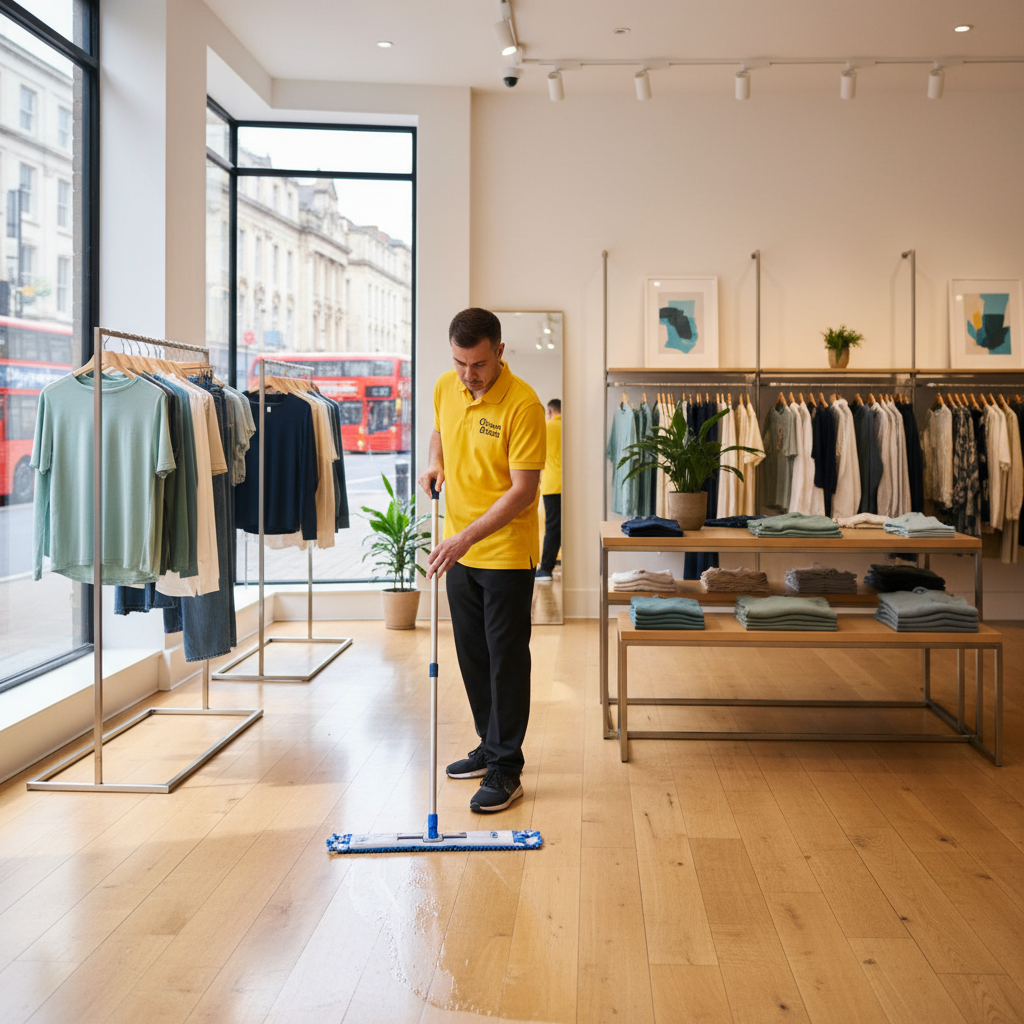
The Gap Between Clean and Actually Clean
Your shop looks fine. The floor’s been swept, the counter’s been wiped, the windows aren’t visibly smeared. Customers walk in, browse, leave. No one complains.
But there’s a difference between a shop that looks acceptable and one that’s genuinely clean — and in retail, that gap matters more than most owners realise. It shows up in staff sick days, in stock that smells faintly musty, in fitting rooms customers avoid, and in the slow erosion of a brand image you’ve worked hard to build.
DIY cleaning in retail isn’t about laziness. Most shop owners who do it themselves, or hand it to staff, are just trying to keep costs down. That’s fair. But the approach tends to miss things — not because people aren’t trying, but because retail has specific cleaning challenges that aren’t obvious until someone with proper experience points them out.
High-Touch Surfaces Get Cleaned. Everything Else Doesn’t.
The most common pattern in DIY retail cleaning is that effort concentrates where dirt is visible. Tills, door handles, countertops — these get wiped daily. The problem is that retail environments accumulate grime in places that don’t look dirty until they really are.
Think about the base of your shelving units. The underside of display tables. The tracks your sliding doors or partitions run along. Ventilation grilles near the ceiling. The area behind your till that’s a maze of cables and boxes. These spots get skipped — not deliberately, but because there are only so many hours in a day and whoever’s cleaning also has other jobs to do.
Changing rooms deserve a specific mention. In most retail settings, they’re cleaned quickly and inconsistently. Hooks, curtain rails, the floor corners, the gap between the floor and the bench — all of these build up with skin cells, hair, and general foot traffic residue. Customers notice more than you’d expect.
Product Choices That Cause Problems
Retail environments often end up with a collection of cleaning products that weren’t chosen for the space — they were just bought from the nearest supermarket or grabbed from a general cleaning order. The issue isn’t that these products are bad. It’s that they’re often wrong for the surfaces being cleaned.
Using the wrong floor cleaner on a specialist surface — polished concrete, luxury vinyl tile, certain laminates — can break down the finish over time. Some glass cleaners leave a residue that’s only visible under certain lighting conditions, but it makes your shopfront look perpetually greasy from the outside. Antibacterial sprays used incorrectly on food-adjacent areas like café counters in clothing stores, or bakery display cases, can fall short of what’s needed from a hygiene perspective.
This is one reason why retail cleaning services in Bristol that actually specialise in the sector use different products and methods than a general office cleaner would. Retail has different surface types, different footfall patterns, and different hygiene considerations depending on what you’re selling.
Frequency vs. Depth: Getting the Balance Wrong
Most DIY retail cleaning schedules involve daily light cleans — and that’s it. Which works fine for a few weeks. Then the grout starts darkening, the entrance mat gets embedded with grit, the stockroom floor develops a sticky patch that never fully shifts, and the windows start looking like they haven’t been done in months (because they haven’t).
Good retail cleaning operates on two levels. There’s the routine work that keeps things presentable day-to-day, and there’s the deeper periodic work that prevents problems from building up. Without both, you end up playing catch-up — either living with a slow decline, or paying for a deep clean that could have been avoided with a sensible regular schedule.
If you want to understand how retail cleaning differs structurally from office cleaning, it comes down to foot traffic patterns, product handling, and the fact that customers are present during trading hours — which changes what you can clean, when, and how.
Staff Time Is Not Free
This one catches people out. When a shop manager or assistant spends 30 minutes cleaning before opening, that’s 30 minutes not spent on merchandising, customer prep, stock checks, or any of the other things that directly affect sales. The cleaning feels free because no separate invoice arrives. But the time cost is real.
For independent retailers particularly, this matters. Time is the most constrained resource. Using staff hours on cleaning tasks that fall outside their core role is an efficiency leak that doesn’t always get counted properly. And if cleaning is being done at the end of a shift when people are tired, or squeezed in during quiet trading moments, the quality suffers.
Professional retail cleaners work outside trading hours, arrive with the right equipment, and complete the job to a defined standard without drawing on your team’s time or attention. For a lot of Bristol shop owners, that trade-off starts making financial sense sooner than they expect.
What Actually Gets Missed
From experience cleaning retail environments across Bristol, here are the spots that DIY cleaning consistently overlooks:
- Entrance mats and threshold areas — Grit gets embedded and tracked further into the store
- Display fixture bases and feet — Dust and debris accumulate underneath and behind units
- Stockroom floors and shelving — Often cleaned far less frequently than the shop floor
- Fitting room fixtures — Hooks, rails, mirrors, and seating get minimal attention
- High-level surfaces — Above eye line, dust builds on shelving tops and ceiling fixtures
- Window interiors — Smears and residue from product placement or customer handling
- Hard floor edges and skirting — Mopping covers the middle; edges and corners get skipped
None of these are dramatic. But collectively they affect how a store feels — and customers respond to how spaces feel even when they can’t articulate exactly why.
The Practical Case for Getting Help
This isn’t an argument that every retail business needs a full commercial cleaning contract immediately. Some smaller operations genuinely manage fine with a structured DIY approach. But if any of the following apply, it’s probably worth a conversation:
- You’ve noticed customers comment on the state of the fitting rooms or entrance
- Staff cleaning is eating into time that should be spent on the business
- Your cleaning schedule is reactive rather than planned
- You’ve had a pest issue that might be linked to food or organic debris in hard-to-reach areas
- You’re approaching a lease renewal or inspection and want the space to look its best
Clean Bees works with retail businesses across Bristol on a contract basis, with employed, DBS-checked staff and cleaning records verified through Xota. If you’d like to talk through what a retail cleaning arrangement might look like for your shop, get in touch via the commercial enquiry form and we’ll put something together that fits your setup.