
If you manage a commercial building in Bristol, you’ve probably been asked this at some point: do we need a deep clean, or is our regular cleaning enough? It sounds like a simple question, but the answer depends on a few things — the type of premises, how heavily it’s used, and what “regular clean” actually means in your current contract.
Let’s break it down clearly, because getting this wrong costs money in either direction. Too little cleaning creates hygiene and compliance risks. Too much (or the wrong type at the wrong time) is just unnecessary spend.
What’s the difference?
A regular clean is exactly what it sounds like — the routine maintenance work that keeps your space presentable on a day-to-day or week-to-week basis. Vacuuming, mopping, wiping down surfaces, emptying bins, cleaning toilets and kitchens. It’s the baseline that stops a workplace from becoming unpleasant. Done consistently, it keeps things ticking over.
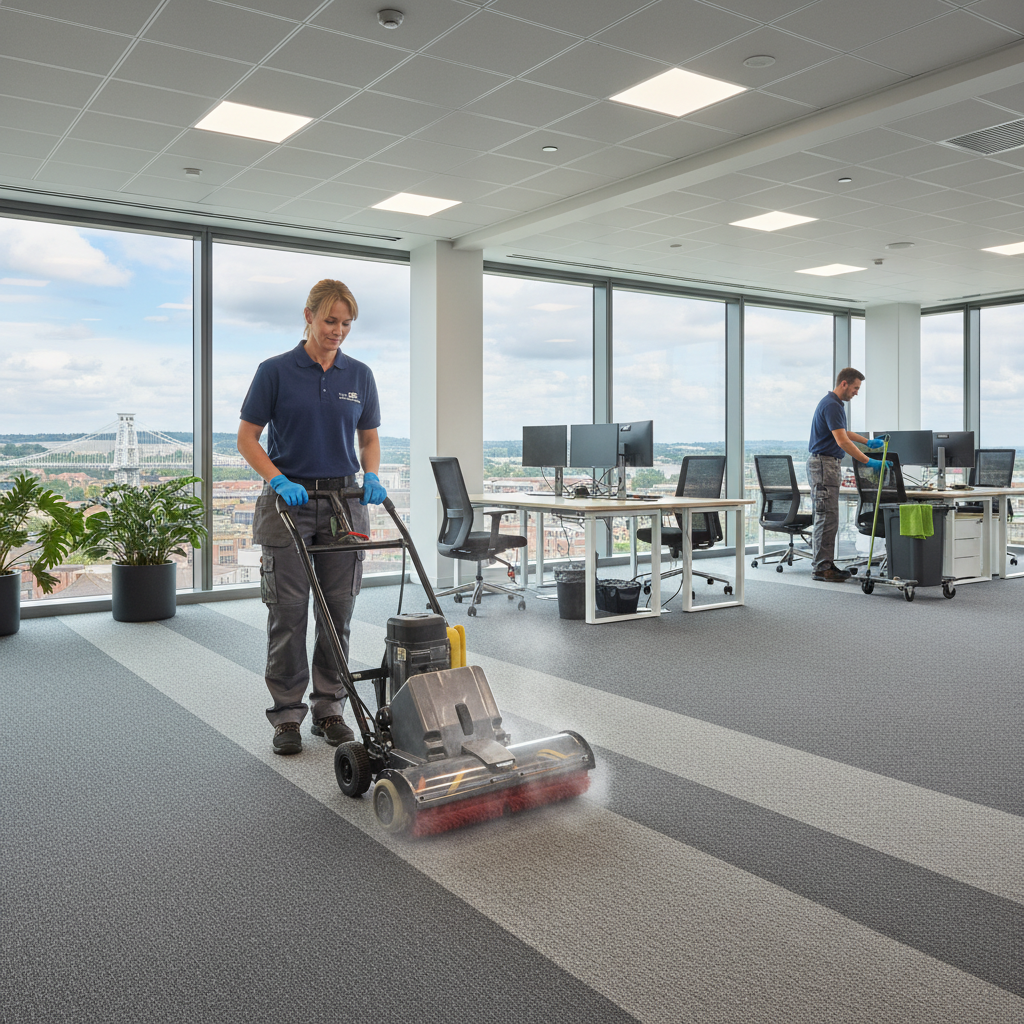
A deep clean goes further. It targets the areas that routine cleaning doesn’t reach — behind appliances, inside ventilation grilles, under desks and furniture, grout lines, upholstered seating, carpet fibres, the tops of partition walls. It’s more labour-intensive, takes longer, and typically uses specialist equipment or chemicals. It’s not designed to happen every week; it’s designed to reset the standard when regular cleaning alone isn’t enough.
Think of regular cleaning as maintenance and deep cleaning as restoration.
When do you need a deep clean?
There’s no universal rule, but here are the situations where a deep clean is genuinely warranted:
- Moving into new premises — even if the previous occupant left it “clean”, a thorough deep clean before your team moves in is worth doing. You don’t know what’s been left in carpets, ducts, or under fixtures.
- Post-construction or refurbishment — builders and fit-out teams leave behind fine dust, debris, and residue that a standard clean won’t shift. This needs specialist post-construction cleaning.
- After a significant event or period of heavy use — a conference, an open day, a particularly busy quarter. High footfall leaves its mark on floors, upholstery, and communal areas.
- Ahead of an audit or inspection — if you’re in healthcare, food service, or any sector with compliance requirements, a deep clean before an inspection isn’t optional. It’s expected.
- Seasonal resets — many businesses do a deep clean two to four times a year as standard. It’s a sensible way to maintain a genuinely clean environment rather than just a surface-level one.
- When standards have slipped — if your regular cleaning contractor has been underperforming and dirt has built up over time, no amount of routine cleaning will fix the problem. You need to reset before you can maintain.
When is regular cleaning enough?
For most commercial buildings running a solid commercial cleaning contract with a reputable provider, regular cleaning handles the day-to-day requirements well. Office floors, reception areas, meeting rooms, washrooms — all of these can be managed through a well-designed regular schedule without the need for constant deep cleans.
The key word there is “well-designed.” A lot of businesses find that their cleaning contract isn’t as comprehensive as they assumed. The schedule might miss certain areas, skip certain tasks, or not be calibrated to the actual volume of people using the space. That gap is where problems build up.
If you haven’t reviewed what your regular clean actually covers recently, it’s worth doing. We’ve written a practical guide on putting together a commercial cleaning schedule that works — it covers frequency, task allocation, and what should be on every cleaning spec by premises type.
The practical answer: you probably need both
For most businesses, the right setup is a consistent regular clean supported by periodic deep cleans. Exactly how that breaks down depends on your premises.
An office with 20 staff might need a regular clean three days a week and a deep clean twice a year. A busy retail unit with high footfall might need daily cleaning and a deep clean every quarter. A school or healthcare setting has different requirements again, driven partly by compliance obligations.
There’s no one-size answer, which is why it’s worth talking through your specific situation with a cleaning provider who understands commercial environments. A good contractor won’t just quote for what you’ve asked — they’ll look at the building, the usage, the surfaces, and what you actually need.
What does a proper deep clean involve?
It varies by premises, but typically a commercial deep clean covers:
- Carpet and upholstery steam cleaning
- Hard floor stripping, scrubbing, and re-sealing
- Full kitchen clean including appliances, extraction, and surfaces
- Descaling and sanitising of all washroom fixtures
- Cleaning behind, beneath, and on top of furniture and equipment
- Window cleaning (internal)
- High dusting — light fittings, ventilation grilles, tops of partitions
- Sanitising of all touchpoints, including door handles, switches, and shared equipment
It’s thorough work and takes time. For most commercial spaces, it’s done out of hours to avoid disruption.
A common mistake: using deep cleans to compensate for poor regular cleaning
Worth flagging this one, because it comes up more than you’d think. Some businesses book a deep clean every month because they’re not happy with how the building looks day-to-day. That’s expensive and it’s the wrong fix. If your daily or weekly clean isn’t maintaining an acceptable standard, the issue is the cleaning specification or the contractor — not the frequency of deep cleans.
Sorting the regular cleaning first is nearly always the right starting point. Get that right, and deep cleans become a planned maintenance activity rather than an emergency reset.
Getting the balance right for your Bristol premises
Whether you’re managing an office block, a school, a retail unit, or a healthcare setting in Bristol, the same principle applies: regular cleaning keeps standards up, deep cleaning restores them when needed. The right balance between the two comes down to your building, your usage, and your obligations.
If you’re not sure whether your current setup is working, or you’re looking at putting a new cleaning contract in place, we’re happy to take a look. Send us an enquiry and we’ll come back to you with a no-pressure assessment of what your premises actually needs — regular, deep, or a mix of both.