
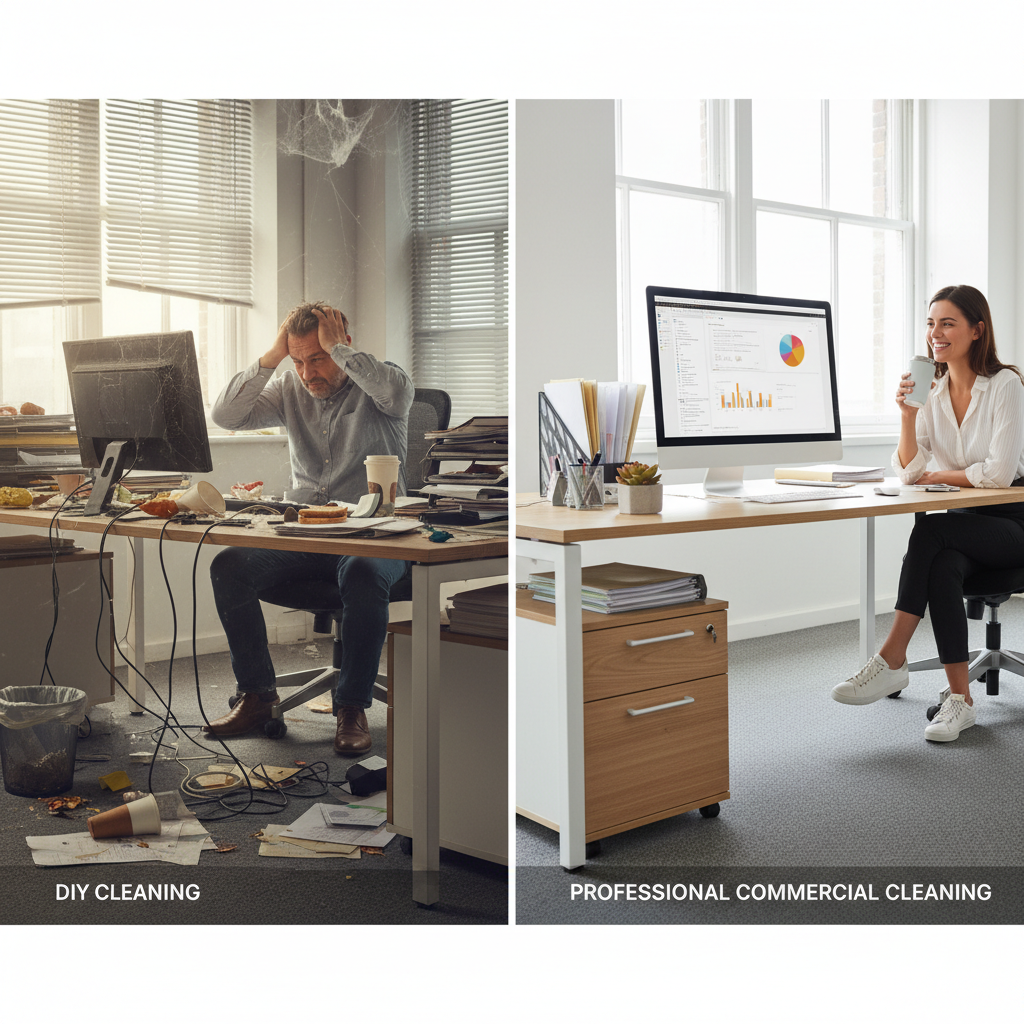
Every business owner reaches the same crossroads at some point: keep handling cleaning in-house, or hand it over to a professional service? On the surface, DIY office cleaning looks like the cheaper option. But once you account for everything — staff time, supplies, equipment, consistency, and the knock-on effects on your workplace — the numbers often tell a different story.
This isn’t about selling you something. It’s a straightforward breakdown of what each approach actually costs, so you can make an informed decision for your business.
The appeal of doing it yourself
It’s easy to see why businesses try to manage cleaning internally. You ask a member of staff to hoover at the end of the day, stock up on some spray bottles from the supermarket, and call it done. No invoices, no contracts, no strangers in the building. For very small offices with just a handful of people, this can work.
But as a business grows, so does the complexity. More desks, more footfall, more surfaces, more bathrooms. What worked for a five-person startup doesn’t hold up in a 40-person office.
The real cost of DIY cleaning
The most common mistake businesses make is treating staff time as free. It isn’t. If you’re paying someone £14 an hour to clean the office for an hour each day, that’s roughly £70 a week — around £3,500 a year — just in direct labour for a basic clean. And that’s before you factor in:
- Cleaning supplies — commercial-grade products cost more than people expect when bought regularly
- Equipment — a decent commercial vacuum, mop, and wet floor signage add up
- Inconsistency — if the person doing the cleaning is off sick or on holiday, the office doesn’t get cleaned
- Reduced focus — staff who clean are not doing their actual jobs during that time
- Missed areas — without professional training, things like door handles, light switches, keyboard trays, and air vents tend to get overlooked
There’s also a health dimension worth considering. Poor cleaning standards have a direct impact on how often your team gets ill. A study by the British Journal of Health found that workplaces with regular professional cleaning saw notably fewer sick days — and if you’re already curious about that angle, it’s worth reading about how professional cleaning affects employee health and reduces sick days.
What professional cleaning actually costs
A commercial cleaning contract for a typical Bristol office — let’s say 2,000 sq ft, cleaned five days a week — will usually sit somewhere between £400 and £700 per month depending on the specification. That includes labour, supplies, insurance, and management.
Against that, consider what you’re getting:
- Consistent cleaning to a fixed standard, regardless of holidays or sickness
- Professional equipment and products used correctly
- Accountability — if something isn’t right, you can raise it
- No HR headaches around managing cleaning as a staff task
- Insurance coverage for any accidental damage
When you compare like for like — the same level of clean, done reliably, five days a week — the cost difference narrows considerably. In many cases, professional cleaning works out cheaper once you strip out the hidden costs of doing it yourself.
The productivity argument
Here’s something that rarely makes it into the cost calculation: what a clean workplace does for the people working in it.
Multiple workplace studies have found that employees in clean, well-maintained offices report higher concentration, lower stress levels, and better overall morale. When desks are cluttered, bins are overflowing, and bathrooms are substandard, it affects how people feel about coming to work — and how they feel about the company they work for.
For facilities managers responsible for maintaining a good working environment, a professional cleaning contract removes one significant variable from the equation. You know the office will be clean. Every day. Without chasing anyone about it.
What DIY cleaning misses
Even with the best intentions, in-house cleaning tends to miss the deeper work. Regular vacuuming and surface wiping keeps things looking acceptable, but it doesn’t address:
- Carpet maintenance and deep extraction
- Hard floor stripping and buffing
- High-level dusting (above ceiling tiles, on top of cabinets)
- Sanitisation of communal touchpoints — lift buttons, door handles, shared equipment
- Kitchen and breakout area hygiene beyond the basics
Over time, the buildup from missed areas starts to show. Carpets look tired, grout goes grey, kitchen surfaces develop a film that surface sprays don’t shift. At that point, you’re usually looking at an intensive deep clean — which costs significantly more than if the work had been maintained consistently.
When DIY makes sense (and when it doesn’t)
To be fair about it: DIY cleaning makes sense in specific scenarios. A one-room studio, a very small team, or a low-traffic workspace with minimal facilities — these can often be managed adequately without a professional service.
But for most commercial offices in Bristol, once you have more than 10 people, shared bathrooms, a kitchen, and regular client visits, professional cleaning is the more practical and often the more cost-effective option. The time your staff spend cleaning is time away from the work they were hired to do. And the inconsistency of ad hoc cleaning tends to compound into larger problems over time.
Finding the right fit for your business
The right cleaning arrangement depends on your space, your budget, and how much variability you’re prepared to tolerate. If you’re considering moving to a professional contract, it’s worth getting a quote based on your actual square footage and specification — rather than assuming it’s out of budget.
Clean Bees provides commercial cleaning services across Bristol and the South West, working with offices, schools, retail premises, communal areas, and more. All cleaning is carried out to a consistent standard with full accountability, and we use the Xota platform to provide photographic evidence of completed work and a client portal for easy communication.
If you’re at the point where in-house cleaning isn’t quite cutting it, or you just want to see what a professional contract would actually cost, fill in our commercial enquiry form and we’ll come back to you with a no-obligation quote based on your specific requirements.
The bottom line
DIY office cleaning is rarely as cheap as it looks. Once you account for staff time, inconsistency, missed areas, and the ongoing cost of supplies and equipment, professional cleaning often comes out ahead — and that’s before you factor in the productivity and health benefits of a consistently clean workplace.
For businesses in Bristol weighing up the options, the honest answer is: run the real numbers, and compare them against a professional quote. The result might surprise you.