
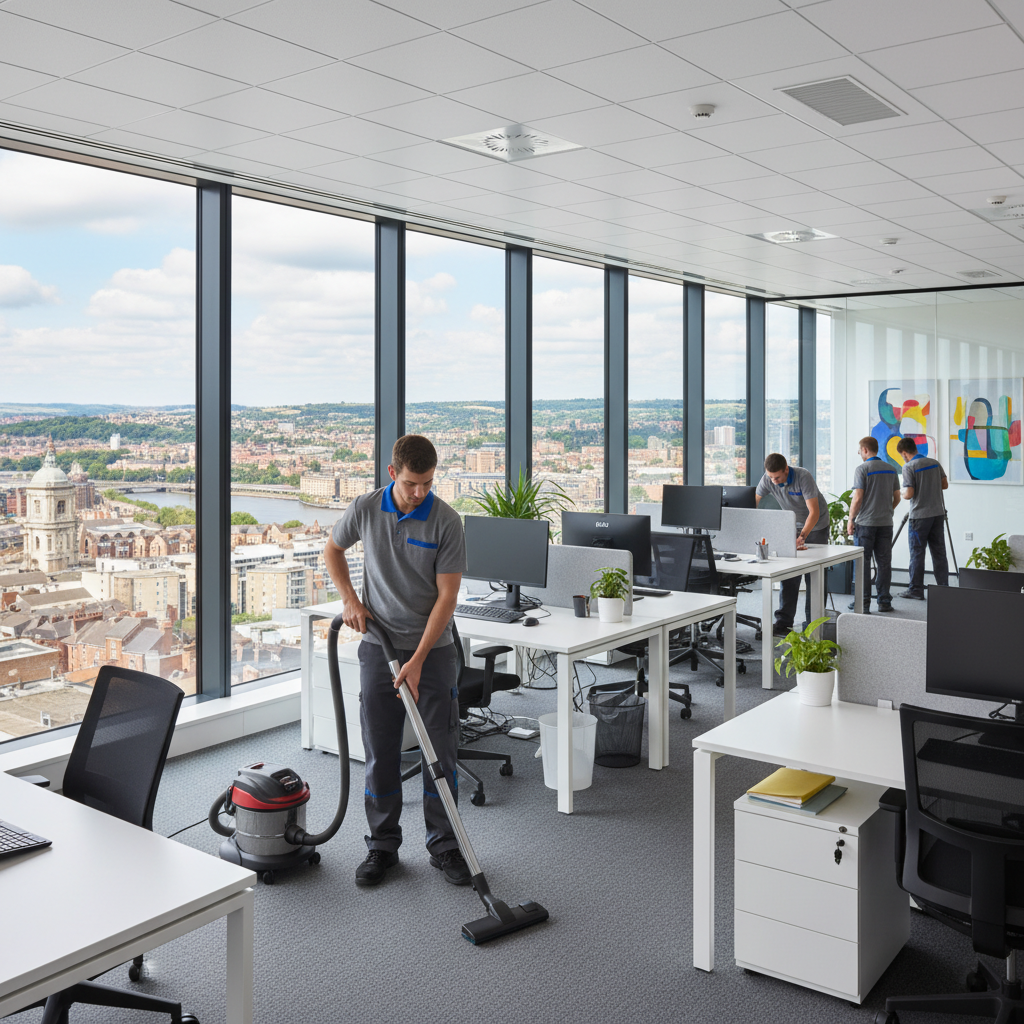
If your office cleaning is happening on a vague “when it looks bad” basis, you’re not alone. A lot of Bristol businesses operate that way until something goes wrong — a client notices a grubby kitchen, a team member raises concerns about hygiene, or a deep clean bill arrives that could’ve been avoided with some routine maintenance.
Getting your commercial cleaning schedule right isn’t complicated, but it does take some thought. The goal is a workspace that stays consistently clean without over-spending on cleaning hours you don’t need.
Why a cleaning schedule matters more than you think
Beyond the obvious visual stuff, a consistent cleaning routine has a direct impact on staff health. The Health and Safety Executive links poor workplace hygiene to higher rates of respiratory illness, stomach bugs and skin complaints — all of which contribute to sick days.
For facilities managers, there’s also a maintenance angle. Carpets that get vacuumed regularly last longer. Hard floors that are properly mopped and treated won’t deteriorate as fast. Kitchens that are cleaned daily won’t build up the kind of grime that requires an expensive deep clean to fix. Routine cleaning pays for itself.
And if you deal with clients or visitors in your building, the state of your workspace is part of your brand. It’s one of the first things people notice.
What needs cleaning daily
Some tasks need to happen every working day, or as close to it as possible. These are the things that deteriorate fastest and have the most impact on how the office feels.
- Emptying bins across the office and kitchen areas
- Wiping down kitchen surfaces, hob, and sink
- Cleaning toilets and replenishing soap, paper towels and toilet roll
- Vacuuming or sweeping high-traffic areas (reception, corridors, open-plan floor)
- Wiping down door handles and light switches — especially in shared areas
- Spot-cleaning any visible marks on desks or surfaces
In a shared office with 20+ people, daily kitchen cleaning is non-negotiable. It only takes a couple of days for things to get out of hand — and once the smell sets in, it affects everyone’s mood (and their opinion of management).
What to tackle weekly
These tasks don’t need to happen every day, but skipping them for more than a week or two tends to cause problems.
- Full vacuum of all carpeted areas, including under desks
- Mopping hard floors throughout
- Wiping down desks and workstations (where clear of items)
- Cleaning internal windows and glass partitions
- Deep-cleaning kitchen appliances — microwave, fridge doors, kettle
- Sanitising toilets, sinks and taps properly
- Dusting shelves, filing cabinets and window sills
The weekly clean is where most of the heavy lifting happens. If you’re working with a commercial cleaning company, this is typically what’s covered under a standard contract — though the exact scope varies depending on the size of your space and how it’s used.
Monthly and quarterly tasks
Some cleaning tasks are easy to forget about because they’re less visible, but they matter.
On a monthly basis, think about:
- Cleaning inside the fridge
- Descaling taps and showerheads (if you have showers)
- Wiping down skirting boards and dado rails
- Checking and cleaning air vents
- Shampooing or spot-treating any carpet stains
Every quarter, it’s worth scheduling:
- External window cleaning
- Deep clean of kitchen equipment
- Full carpet clean (steam or dry-clean depending on carpet type)
- Cleaning behind large furniture and appliances
- Checking condition of grout, seals and silicone in bathrooms
Annual tasks — like duct cleaning, high-level cleaning of ceilings and light fittings, or a full deep clean — are worth building into your facilities budget so they don’t get overlooked.
Adjusting for your specific workspace
Not every office is the same, and your cleaning schedule should reflect how your space is actually used.
A busy open-plan office with 50 staff needs significantly more frequent cleaning than a small consultancy with 8 people. If you have a staff canteen rather than just a small kitchen, that changes things considerably. If you’re in a sector with specific hygiene requirements — healthcare, food, education — those standards need to be built into the schedule from the start.
For Bristol businesses in shared buildings or managed spaces, block cleaning and communal area maintenance are worth thinking about separately from your own office cleaning. Communal spaces — stairwells, lifts, shared toilets — often fall under a different contract or are managed by the building owner, but if they’re not being maintained properly, it reflects on your business too.
Some questions worth asking when reviewing your cleaning needs:
- How many people use the space daily?
- Do you have clients or visitors coming in regularly?
- What are the highest-traffic areas?
- Do you have any regulatory or compliance requirements?
- What time of day works best for cleaning — before or after hours?
In-house versus a cleaning contract
Some businesses try to manage cleaning in-house, asking staff to keep their own areas tidy. This works to a point — personal desk tidiness is reasonable to ask of employees — but relying on staff to clean shared areas creates friction, inconsistency, and often resentment.
A commercial cleaning contract gives you a consistent standard, liability coverage, trained staff, and the right equipment and products. You also get access to specialist services (deep cleans, carpet cleans, post-construction cleans) that aren’t practical to manage internally.
For most Bristol businesses, the cost of a commercial cleaning contract is offset quickly by the time saved, the consistency delivered, and the reduction in ad-hoc cleaning bills when things are left too long.
Getting started
If you’re putting together a cleaning schedule from scratch, start by walking your space and noting what gets dirty first and fastest. Talk to your team — they’ll tell you quickly where the pain points are. Then build a schedule that covers the basics daily, the fuller clean weekly, and builds in the deeper tasks on a monthly or quarterly cycle.
If you’d rather hand that thinking to someone else, Clean Bees offers commercial cleaning contracts across Bristol tailored to your space and how it’s used. We’re not a one-size-fits-all operation — we’ll put together a schedule that works for your building, your team, and your budget.
Get in touch to talk through what you need. We work with offices, retail spaces, schools, blocks and more across Bristol and the surrounding area.