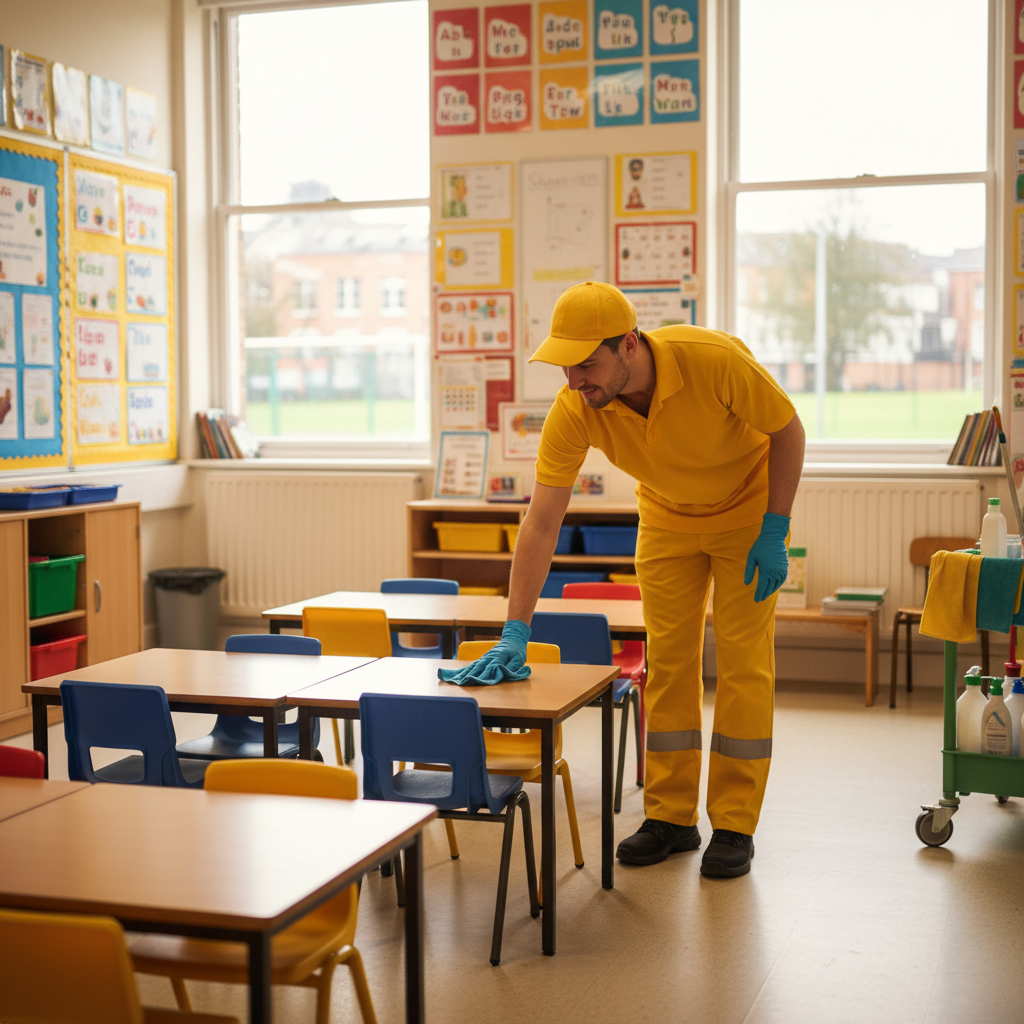
A Mop and a Bucket Isn’t Enough
Most schools in Bristol have some form of cleaning in place. Someone comes in before or after hours, wipes down surfaces, empties the bins, runs a mop around the corridors. Job done. But if you’re a head teacher, bursar, or school administrator, you already know that keeping a school genuinely clean is nothing like cleaning an office or a retail unit.
Schools are high-contact, high-footfall environments with specific hygiene obligations, regulatory expectations, and a duty of care that goes well beyond appearances. A general cleaner — however reliable — simply isn’t set up to handle all of that. That’s the case for specialist school cleaning, and it’s worth understanding what the difference actually looks like in practice.
What Makes Schools Different
Think about what happens inside a school building on a typical day. Hundreds of children moving between classrooms, touching door handles, sharing equipment, using toilets, eating lunch. Spillages, muddy shoes, paint on desks, tissue waste, and the general chaos of communal life with young people.
Then think about the spaces themselves. Classrooms, toilets, changing rooms, science labs, dining halls, sports halls, staff rooms, reception areas. Each has different surfaces, different cleaning requirements, and different risk levels. A dining hall needs a different approach to a chemistry lab. The toilets used by primary-age children need more frequent attention than a staff kitchenette.
General cleaners tend to apply the same routine everywhere. That might be fine for a small office, but in a school it leads to gaps — and those gaps are where hygiene problems start.
The Health and Safety Side Is Serious
Schools are legally required to maintain safe environments under health and safety legislation. That means cleaning protocols need to go beyond surface appearances. Cross-contamination is a real concern, particularly in areas where food is prepared or consumed. Illness spreads fast in school environments, and the cleaning regime is one of the main controls that limits that.
Specialist school cleaning teams understand the difference between cleaning and disinfecting. They know which products are safe to use around children and which aren’t. They know that a cleaning cloth used in a toilet shouldn’t end up on a classroom desk — which sounds obvious, but without proper colour-coded systems and trained staff, it happens.
There’s also COSHH (Control of Substances Hazardous to Health) compliance to think about. Cleaning products used in schools need to be appropriate, correctly stored, and used by staff who are trained in handling them. That’s not something a general cleaner can necessarily guarantee.
For a more detailed look at how Bristol schools stay on top of these requirements, this post on how Bristol educational facilities maintain safe environments covers the practical side in depth.
Inspection Readiness Isn’t Optional
Ofsted visits are a reality for every school, and cleaning standards are part of what inspectors observe. A poorly maintained environment affects the impression of the school. More practically, it can flag safeguarding and health concerns that have a direct impact on ratings.
Specialist school cleaning services in Bristol are built with this in mind. Documented cleaning schedules, sign-off logs, product records — these are the kind of audit trails that matter when an inspection happens. A general cleaner working on a handshake agreement can’t provide that.
Safeguarding Doesn’t Stop at People
Safeguarding in schools usually refers to child protection, but the physical environment is part of that picture too. Cleaning staff who work in schools need to be DBS-checked. That’s not a nice-to-have — it’s a requirement for anyone with regular, unsupervised access to school premises.
A general cleaning company may not have DBS checks in place for its staff, or may not be able to provide evidence of them. A specialist school cleaning provider will have this covered as standard, and will be able to provide documentation if required.
Clean Bees employs its own staff directly — no agency workers, no subcontracting. Every team member is DBS-checked and trained specifically for the environments they work in. That matters particularly for schools, where the people doing the cleaning need to meet the same safeguarding standards as everyone else on site.
The Practical Differences Day to Day
Here’s what specialist school cleaning actually looks like compared to a general cleaning service:
- Colour-coded equipment — separate cloths, mops and buckets for different zones (toilets, kitchens, classrooms) to prevent cross-contamination
- Appropriate products — child-safe disinfectants and surface cleaners, correctly diluted and used, with COSHH records maintained
- Zone-specific routines — different cleaning frequencies and methods for high-risk areas like toilets, dining halls and science rooms
- Documented sign-off — cleaning logs that give you a record of what was done, when, and by whom
- Responsive to term times — schedules that flex around school holidays, deep cleans during breaks, and additional attention before term starts
These aren’t minor details. They’re the difference between a school that can demonstrate good hygiene practice and one that can’t.
Term-Time Flexibility Matters
School cleaning has a rhythm that most other commercial cleaning contracts don’t. There are term-time schedules, holiday deep cleans, pre-term preparation and ad hoc requirements during events or after incidents. A general cleaner with a fixed weekly routine can’t adapt to that easily.
Specialist providers plan around the academic calendar. Deep cleans happen during summer, half-term and Easter. The days before term starts are used to make sure every classroom, corridor and common area is ready. That kind of scheduling takes experience — you need to know how a school actually works to clean it effectively.
What to Look for When Choosing a School Cleaning Company
If you’re reviewing your current cleaning provision, or looking for a new provider, here are the things worth checking:
- Are all cleaning staff DBS-checked, with records available on request?
- Does the provider have experience specifically in school environments?
- Can they provide documented cleaning schedules and sign-off logs?
- Do they have colour-coded systems in place for cross-contamination prevention?
- Are they flexible enough to accommodate term dates and deep clean requirements?
- Can they provide references from other schools they currently service?
These questions quickly separate specialist providers from general ones.
Clean Bees Works With Bristol Schools
Clean Bees provides specialist school cleaning services in Bristol, working with primary and secondary schools, academies and independent schools across the city. Our teams are employed directly, DBS-checked and trained for school environments — not generalists drafted in from elsewhere.
We work around your academic calendar, provide documented cleaning records, and use the Xota platform to give you photo-verified evidence of completed cleans. If your school is coming up to a contract review, or you’re not satisfied with your current provider, it’s worth having a conversation.
Get a free cleaning quote — no obligation, just a straightforward discussion about what your school needs.